
- Quick Menu Enroll Now | Student Login
- Student Helpline +91-9540501166
- Contact email info@iipts.ac.in

The Bachelors Program in Metallurgical Engineering (BMLE) is a career-focused 4-year undergraduate program designed to develop strong knowledge of metals, alloys, materials science, and industrial metallurgy. Offered through Distance Learning Mode by Integrated Institute of Professional & Technical Studies (IIPTS), the program provides flexible learning for students and working professionals. The curriculum covers fundamental engineering concepts along with key areas such as mineral processing, metal extraction, physical and extractive metallurgy, metallurgical thermodynamics, heat treatment, foundry technology, welding, corrosion engineering, materials testing, characterization, and quality control. Students learn how raw minerals are transformed into useful metals and high-performance materials, and how their properties can be improved for industrial applications. The program also introduces modern practices in advanced materials, sustainable metallurgy, recycling, surface engineering, and industrial quality management. Combining theoretical learning with industry-oriented knowledge, BMLE prepares learners for technical and supervisory opportunities in steel, mining, manufacturing, automotive, construction, energy, material testing, and engineering industries.
After completing the Bachelors Program in Metallurgical Engineering (BMLE), learners develop essential technical and professional skills required for metallurgy, materials, manufacturing, and engineering industries. Students gain knowledge of metals, alloys, material properties, phase transformations, metallurgical thermodynamics, and materials characterization. The program develops practical understanding of mineral processing, metal extraction, refining, casting, forming, welding, heat treatment, and surface engineering. Learners also build skills in mechanical testing, corrosion control, quality inspection, failure analysis, and material defect identification. They learn to apply engineering principles, phase diagrams, thermodynamics, and process knowledge to evaluate material performance and improve manufacturing processes. The program further strengthens problem-solving, analytical thinking, technical reporting, documentation, production planning, quality management, and industrial safety skills. Students also gain awareness of sustainable material practices, process optimization, and modern materials technologies. These skills prepare graduates to contribute effectively to production, quality control, inspection, materials testing, manufacturing, and metallurgical operations across diverse industrial environments.
Completing the Bachelors Program in Metallurgical Engineering (BMLE) from IIPTS provides learners with formal academic documentation of their program completion, subject to applicable institutional policies and requirements. The credential demonstrates structured learning in metallurgical engineering, materials science, metal processing, testing, and industrial metallurgy. It can strengthen a learner’s professional profile by documenting academic progression alongside existing technical knowledge and industry experience. The BMLE credential can be included in a résumé, professional profile, job applications, and academic records, where accepted by the relevant employer or organization. Completing a structured four-year distance-learning program also demonstrates qualities such as self-discipline, time management, consistency, and commitment to professional development. The qualification may support learners seeking opportunities in metallurgy, materials, manufacturing, quality control, production, inspection, and related engineering fields, depending on applicable eligibility requirements. Learners should verify recognition, equivalence, eligibility, and employer-specific requirements before using the qualification for regulated employment, higher education, government recruitment, or other purposes requiring specific accreditation.

Choosing Integrated Institute of Professional & Technical Studies (IIPTS) for the Bachelors Program in Metallurgical Engineering (BMLE) can be suitable for learners seeking a flexible and structured approach to technical education through Distance Learning Mode. The four-year program provides a progressive learning pathway, beginning with engineering fundamentals and advancing to specialized areas of metallurgy and materials science. The curriculum focuses on important industry-oriented subjects such as metals and alloys, physical and extractive metallurgy, mineral processing, heat treatment, welding, foundry technology, corrosion, materials testing, characterization, manufacturing processes, and quality management. Distance learning provides flexibility for working professionals and students managing career or personal commitments. IIPTS offers a structured academic environment that helps learners develop technical knowledge, analytical thinking, and problem-solving abilities relevant to metallurgical and materials-based industries. Before enrollment, prospective students should review admission criteria, curriculum, assessment procedures, study support, and applicable recognition or equivalence requirements to ensure the program aligns with their academic and career goals.
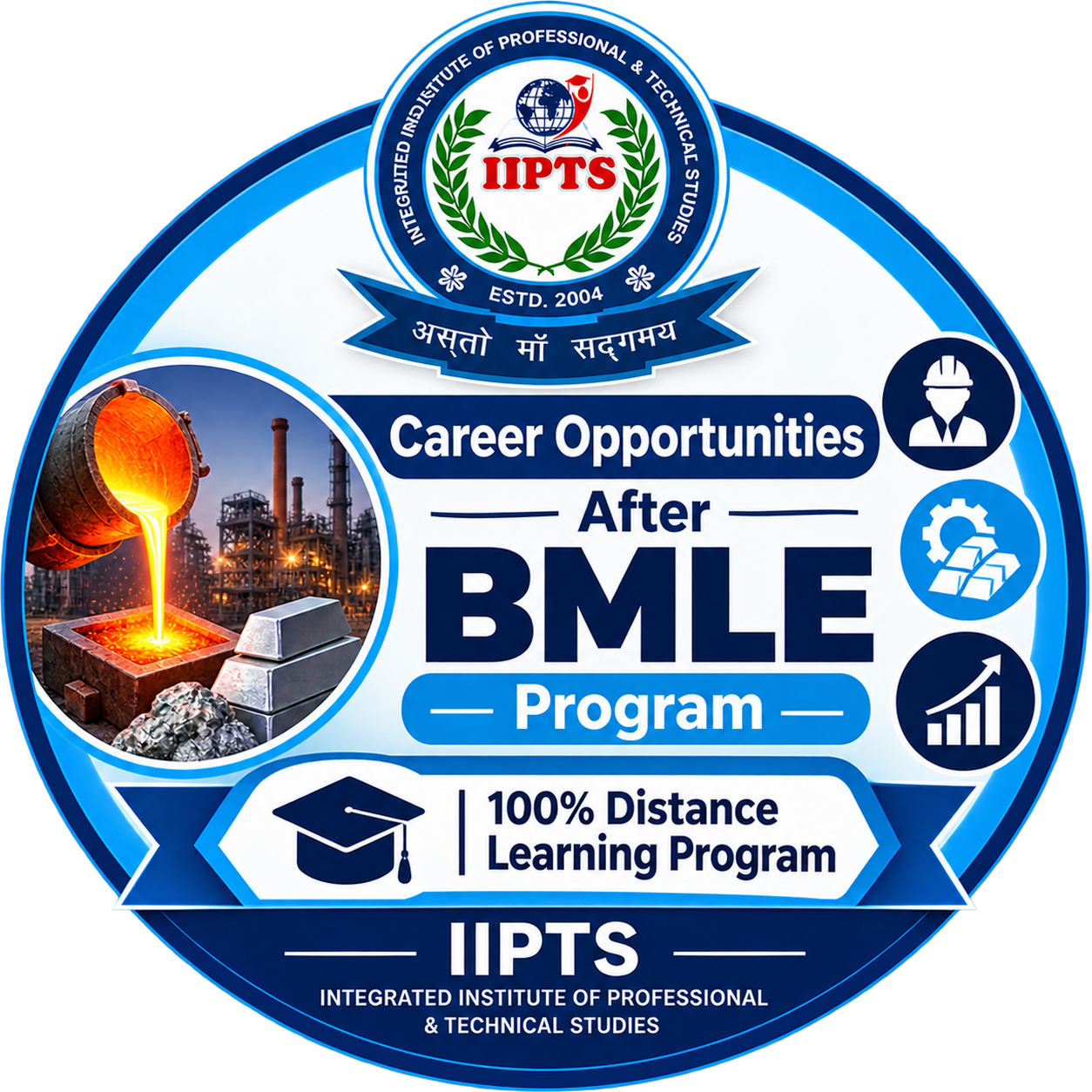
The Bachelors Program in Metallurgical Engineering (BMLE) can provide a strong foundation for career opportunities in metallurgy, materials, manufacturing, production, quality, and industrial engineering. After completing the program, learners may explore roles such as Metallurgical Engineer, Materials Engineer, Production Engineer, Quality Control Engineer, Foundry Engineer, Welding Engineer, Heat Treatment Engineer, Inspection Engineer, Materials Testing Professional, and Corrosion Engineer. With relevant experience and specialized skills, graduates may also progress toward responsibilities in process optimization, failure analysis, plant operations, and research and development. BMLE graduates can find opportunities across steel and metal production, mining and mineral processing, foundries, automotive manufacturing, heavy engineering, fabrication, construction equipment, energy, aerospace supply chains, railways, and industrial manufacturing. Emerging areas such as electric vehicles, advanced materials, additive manufacturing, recycling, and sustainable metallurgy may also offer growing opportunities. Career progression depends on academic qualifications, practical knowledge, work experience, technical skills, employer requirements, and applicable industry standards. Additional certifications, testing skills, quality-management knowledge, and industrial exposure can further strengthen career prospects.
Salary after completing a Bachelors Program in Metallurgical Engineering varies according to job role, industry, location, technical skills, experience, and employer.
Explore other streams in the same category that might interest you.

 IIPTS Academic
Bachelors Program in Electronic & Telecom Engg. (BET)Course OverviewThe Bachelors Program in ...
IIPTS Academic
Bachelors Program in Chemical Engineering (BCCE)Course OverviewThe Bachelors Program in Chemical ...
IIPTS Academic
Bachelors Program in Electrical Engineering (BEE)Course OverviewThe Electrical Engineering progra...
IIPTS Academic
Bachelors Program in Electronics Engineering (BELE)Course OverviewThe Bachelors Program in Electr...
IIPTS Academic
Bachelors Program in Mechanical Engineering (BME)Course OverviewThe Bachelors Program in Mechanic...
IIPTS Academic
Bachelors Program in Production Engineering (BPE)Course OverviewThe Bachelors Program in Producti...
IIPTS Academic
Bachelors Program in Electrical & Electronics Engineering (BEEE)Course OverviewThe Bachelors ...
 IIPTS Academic
Bachelor's Program in Automobile Engineering (BAE)Course OverviewThe Bachelor's Program in Automo...
IIPTS Academic
Bachelors Program in Civil Engineering (BCVE)Course OverviewThe Bachelor's Program in Civil Engin...
IIPTS Academic
Bachelors Program in Computer Engineering (BCE)Course OverviewThe Bachelor’s Program in Computer ...